Market Notes
Canton Fair 2026: What Homeware Buyers Are Looking For
The 140th Canton Fair runs 15 October to 4 November 2026. What homeware buyers are asking for now, and how to shortlist without flying in.
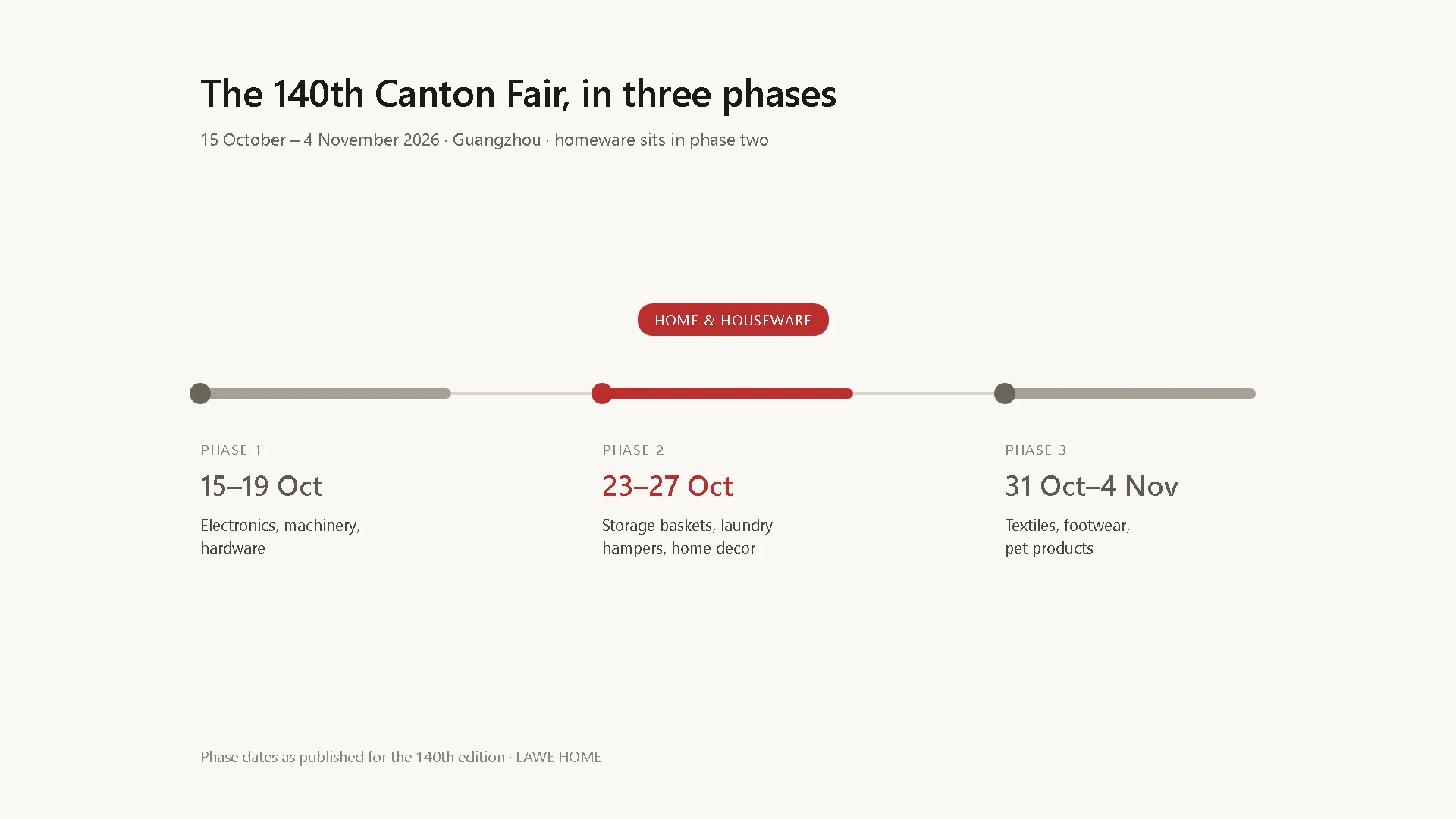
The 140th Canton Fair opened on 15 October and runs to 4 November. Homeware sits in phase two, 23 to 27 October. Whether you are flying in for that window or working it from a desk, the questions buyers bring have shifted.
The Dates That Matter
Three phases, three product groups:
- Phase 1, 15–19 October. Electronics, machinery, hardware.
- Phase 2, 23–27 October. Consumer goods, home decor, houseware.
- Phase 3, 31 October–4 November. Textiles, footwear, pet products.
Storage baskets, laundry hampers and pet beds fall across phases two and three. A buyer sourcing the full home range usually needs both windows, or one agent covering both.
What Buyers Ask For Now
Three years of freight volatility changed the opening question. It used to be "what is your best price". It is closer to "what does this cost me landed, and what happens if it arrives damaged".
In practice that means:
Specification before design. Buyers arrive with a tolerance band and a weight target, not a photo. A supplier who can hold ±3% on dimensions and ±5% on weight gets the second meeting.
Fewer materials, deeper. A buyer used to sample eight materials. Now they shortlist three and test them properly. Paper rope and cotton rope come up most often — one folds, one compresses, and both load densely.
Packaging as a line item. Since PPWR, packaging is quoted rather than assumed. Buyers ask for the recycled content figure and the carton weight before they ask for the price.
Small first orders. MOQ conversations have moved. A 100-piece-per-colour opening order is now normal for a new relationship, with volume following a clean first shipment.
Colour consistency across reorders. Requests for a colour standard, not a colour photo, have gone up. It is the cheapest way to avoid a second production run.
Working the Halls in Two Days
Phase two runs five days. Most buyers have two.
- Book meetings before you fly. The serious suppliers are booked out by day two.
- Bring tolerance and target price in writing. Verbal specs turn into wrong samples.
- Ask for the sample lead time, not the sample. Anyone can hold up a basket. Ask how long a new one takes.
- Walk the material halls before the product halls. You read the product halls faster once you know what the material costs.
If You Are Not Going
Most of what the fair gives you is available remotely, if you ask in the right order.
- Start with the material. Decide the two or three you will actually test. That narrows the supplier list faster than any product search.
- Ask for a specification sheet before a quote. A quote with no tolerance band is a guess.
- Request a photo report from a past shipment. It tells you more about how a supplier works than a catalogue does.
- Order one sample, not five. Test it against your tolerance before scaling the relationship.
The Weeks After the Fair
Enquiry volume peaks in the two weeks after each phase closes. Suppliers are working through hundreds of follow-ups and the queue is real.
Two things move you up it: send the specification early, and be specific about volume. A message that says "send me your catalogue" gets a catalogue. A message with a material, a size, a tolerance and a target quantity gets a production slot.
Frequently Asked Questions
Do I need to attend both phases?
Only if you buy across home and pet. Storage and laundry are in phase two; pet beds sit in phase three. One trip covering both means staying through, or splitting the visit between two colleagues.
Is the fair still the best place to find new suppliers?
For a first look, yes — you can compare forty suppliers in two days. For a decision, no. Tolerances, sampling time and inspection practice are easier to judge from a sample order than from a stand.
What should I bring to a first meeting?
A specification sheet with tolerance and weight, a target landed cost, and your first-order volume. Suppliers who get those three answer differently from suppliers who get a photo.
Our material range is on our materials page, and finished products are grouped in our collections. If you are comparing freight after the show, our note on container space and material choice covers how loading changes with the material.