Compliance & Logistics
How Material Choice Changes Container Space and Freight Cost
How folding, nesting and moisture risk decide how many baskets fit in a container, and what that does to your landed cost per unit.
A 40HQ container holds about 68 cubic metres of usable space. Nothing you decide about that container matters more than how much of it your baskets occupy.
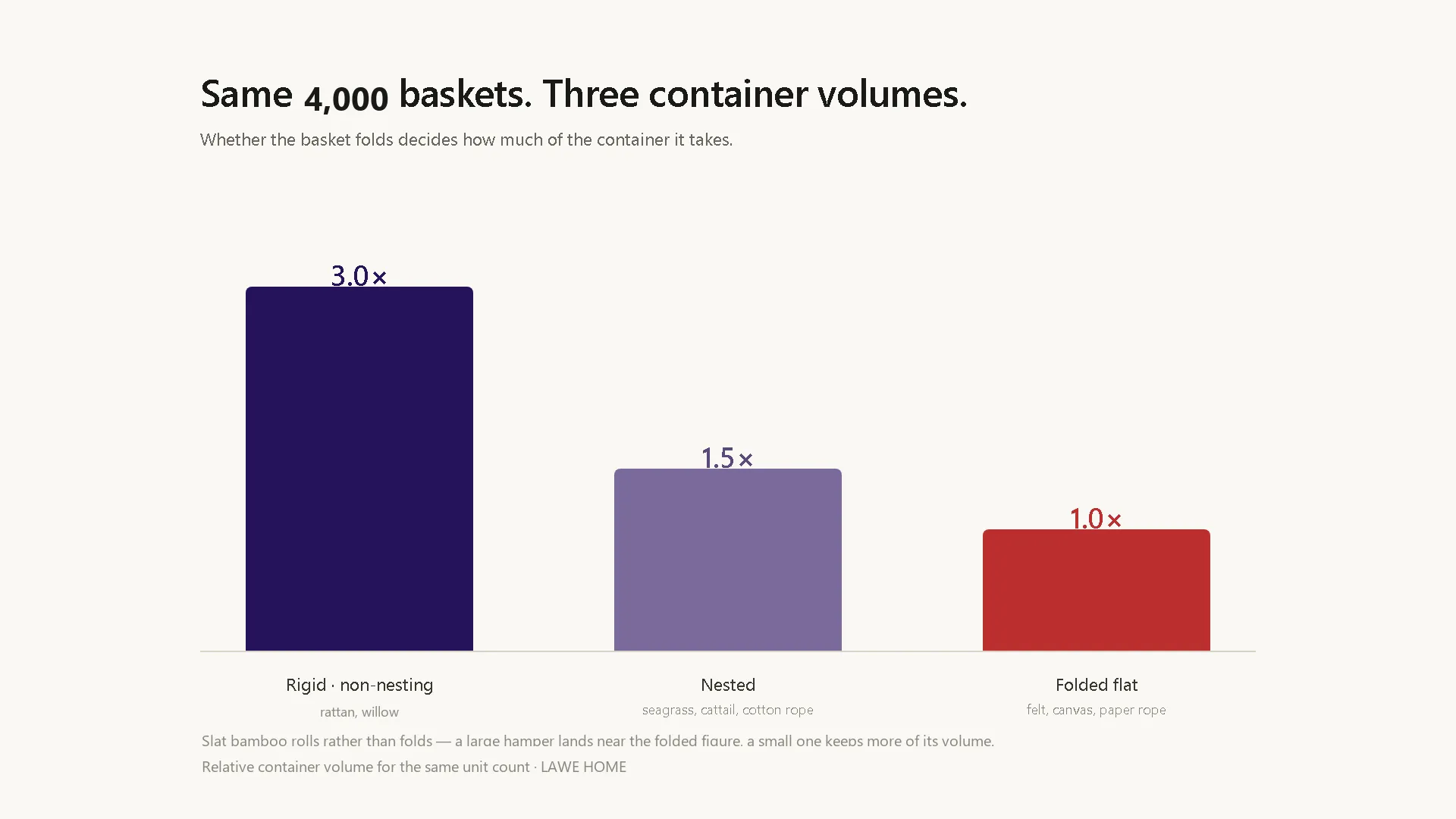
Two orders of 4,000 units can fill one container and three containers. Same product, same destination, different material.
We quote FOB, so freight is not in our price — your forwarder bills it. This post gives you the loading data to price it yourself.
Space Is Decided Before Production
Freight is charged per container or per cubic metre. Both are set by volume, not by unit count.
A rigid basket that nests loads denser than one that does not. A soft basket that folds flat loads denser still. On most routes the gap in freight is bigger than the gap in unit price between two suppliers.
That is why we ask about volume at quotation. Our FOB price does not change with loading; your carton count and freight do. Carton dimensions and units per carton go out with every quote.
Six Materials, Six Loading Behaviours
Every material in our range loads differently. This is the table we use when sizing a container.
Material | Folds or rolls flat | Nests | Moisture risk on a 30–40 day route | Loading note |
Seagrass, cattail, bulrush | No | Yes | High | Natural fibre holds ambient moisture; needs liner and desiccant |
Bamboo, slat or woven | Slat panels roll | No | Medium | Rolls into a bundle; strap it or the slat edges kink |
Rattan, willow | No | Limited | Medium | Strong and rigid, and the bulkiest option per unit |
Cotton rope | No | Yes | Medium | Compresses under load; cotton absorbs water |
Paper rope | Partly | Yes | High | Paper loses strength when damp; most moisture-sensitive option |
Fabric, felt, canvas | Yes | Yes | Low | Folds flat; densest loading per unit in the range |
The spread is wide. Felt and canvas fold to a fraction of their open height. A slat bamboo hamper rolls into a bundle several times smaller than the open basket. A seagrass basket nests, but every rim still costs height. Rattan does neither.
A rolled hamper saves less on a small size than a large one. The roll keeps roughly the same thickness whatever the diameter, so it takes a bigger share of a 30 cm basket. Ask for the figure on the size you buy — there is no single number for the range.
The Arithmetic Behind Landed Cost
Landed cost is what the goods cost you in total: unit price plus freight, duty and handling, divided by units sold. Freight is the part material choice moves most, and the part we do not quote.
Take 4,000 laundry hampers at 40 cm diameter and 50 cm height.
- Rigid, non-nesting. Every unit takes its full footprint and full height. The order needs three containers.
- Nesting. Units stack into each other. The same order drops to roughly half the volume — one and a half containers.
- Folding flat. Units compress to a flat pack, often to a third of the rigid figure — one container.
- Rolling. A slat bamboo hamper rolls instead of folding. How much it saves depends on diameter: a large hamper rolls down close to the flat-pack figure, a small one keeps more of its volume.
Unit prices for these differ. Freight does not differ by a few percent. It differs by a factor.
Put a 12% higher unit price against a lower freight line and the folding option wins on landed cost, even though it loses on the FOB quote. That comparison is yours to run — we never see your freight rate.
We do not publish a saving percentage; it depends on route, season and loading plan. We publish the method instead, so you can run it on your own numbers.
Moisture Is the Cost You Do Not See on the Invoice
Natural fibre baskets travel four to six weeks, often through three climate zones. Seagrass, bamboo and paper rope all take up moisture from the air inside a container.
The damage arrives as pale bloom on the weave, a musty smell, dark spots that will not brush off. It is not a manufacturing defect and most cargo insurance will not cover it. It is a shipping condition.
Four things reduce the risk.
Liners. A PE or barrier liner around the pallet, sealed at the top. Small cost per container, large difference on natural fibre.
Desiccant. Container bags sized to the internal volume, at the doors and along the walls. We size this with the forwarder for the route, not with one number for every order.
Loading pattern. Leave a gap at the doors and keep cartons off the roof, so condensation runs down the walls instead of into the cartons.
Route and season. A direct sailing in a dry season beats a transhipment through a humid port in the rains. When the schedule allows, that is free risk reduction.
For paper rope and untreated seagrass we quote moisture protection as part of the order rather than as an option. It cannot be added once the container is loaded.
What We Ask Before Sizing a Container
A container plan needs five answers:
- Material and construction — folding, nesting or rigid.
- Order quantity and the SKU split. Mixed SKUs load differently.
- Destination port, and whether you can take a full container.
- Whether mixed materials can share a container. They often can, with a partition.
- Target arrival window. This decides the route and, with it, moisture exposure.
With those five we return a volume estimate, carton dimensions and units per carton alongside the FOB price. Freight is quoted by your forwarder, but you will have the numbers to price it.
Frequently Asked Questions
Does a folding basket cost more per unit?
Usually yes. The frame, the fabric weight and the stitching take more work. On most routes the freight difference is bigger than the price difference, but a small order may not cross the line.
Does a rolled slat hamper hold its shape?
Yes, if the base and rim are rigid and the bundle is strapped in the carton. Slat edges kink on a loose bundle, so we strap every one.
How much does moisture protection add?
It shows up on our invoice, not on the freight bill: liner and desiccant as a separate line, a small share of goods value.
Can one container mix seagrass and felt?
Yes. Natural fibre goes away from the doors and the two are separated with a liner. Mixed loads are common for buyers testing a new material.
The full material range, with loading notes for each, is on our materials page. Finished products grouped by material are in our collections. For how we check goods before dispatch, see our pre-shipment inspection walkthrough. Packaging decisions that change volume are covered in our PPWR checklist.
If you are meeting suppliers at Canton Fair, our guide to the 140th edition covers what to ask before the second meeting.