Compliance & Logistics
Packaging Choices That Cut Both Waste and Freight Cost
Air inside your carton costs you twice: as packaging waste and as container space. How the common materials compare, plus three changes for your next order.
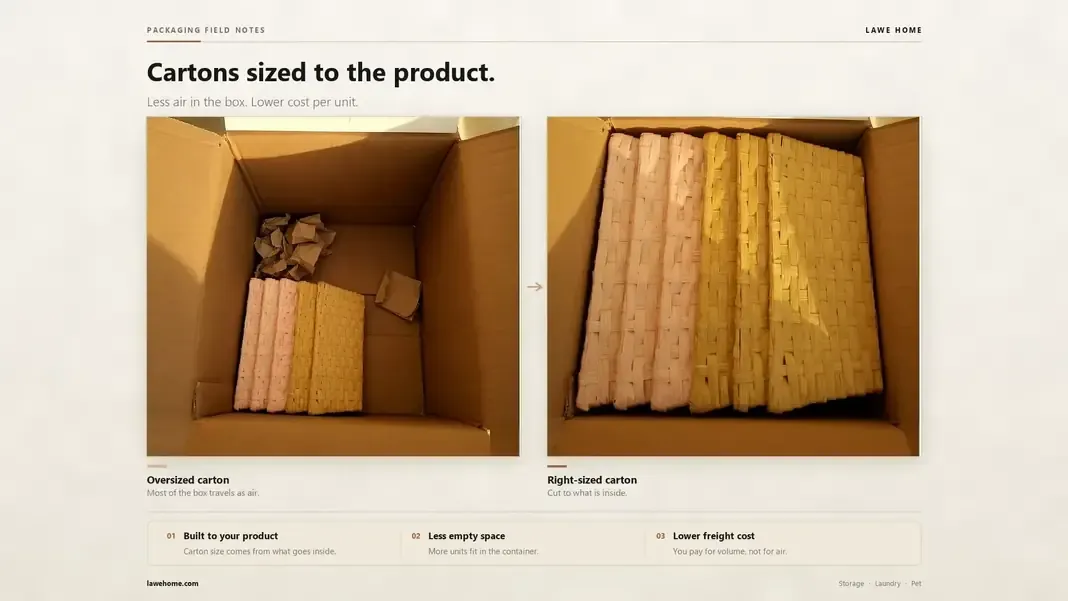
Most buyers treat packaging as protection. It is also a freight cost.
A carton bigger than it needs to be is waste on one side of the ledger and container space on the other. Fix one and you usually fix both. Below: how the materials we use most compare, why overpackaging rarely shows up as a compliance problem until it reaches your freight bill, and three changes you can make on the next order.
Air You Pay For
A storage basket fills 18 litres when assembled. It ships in a 30 litre carton. Twelve litres of that carton is air.
PPWR expects grouped, transport and e-commerce packaging to cut avoidable empty space. The freight argument is simpler. Homeware runs out of container volume before it runs out of weight, so a carton that is 20% air is roughly 20% of your units left on the quay.
Too tight is expensive as well. A crushed basket costs more than the space it saved. Aim for the smallest carton that still protects the goods.
How the Common Materials Compare
Ratings are relative, for homeware shipped from China to Europe and North America. Your specification may differ.
Packaging material | Recyclability | Crush / stacking | Volume | Cost | Retail look |
Single-wall corrugated carton | High | Medium | Medium | Low | Basic |
Double-wall corrugated carton | High | High | Slightly higher | Medium | Basic |
Moulded fibre or pulp insert | High | High | Low to medium | Medium | Good |
Kraft paper void fill | High | Cushions only | Low | Low | Fair |
Paper honeycomb corners | High | High, replaces foam | Low | Medium | Fair |
LDPE polybag | Low | None | Very low | Very low | Hidden |
EPE or foam insert | Low | High | Medium to high | Medium to high | Good |
Vacuum compression film | Low | Not applicable | Very low | Low | Not for retail |
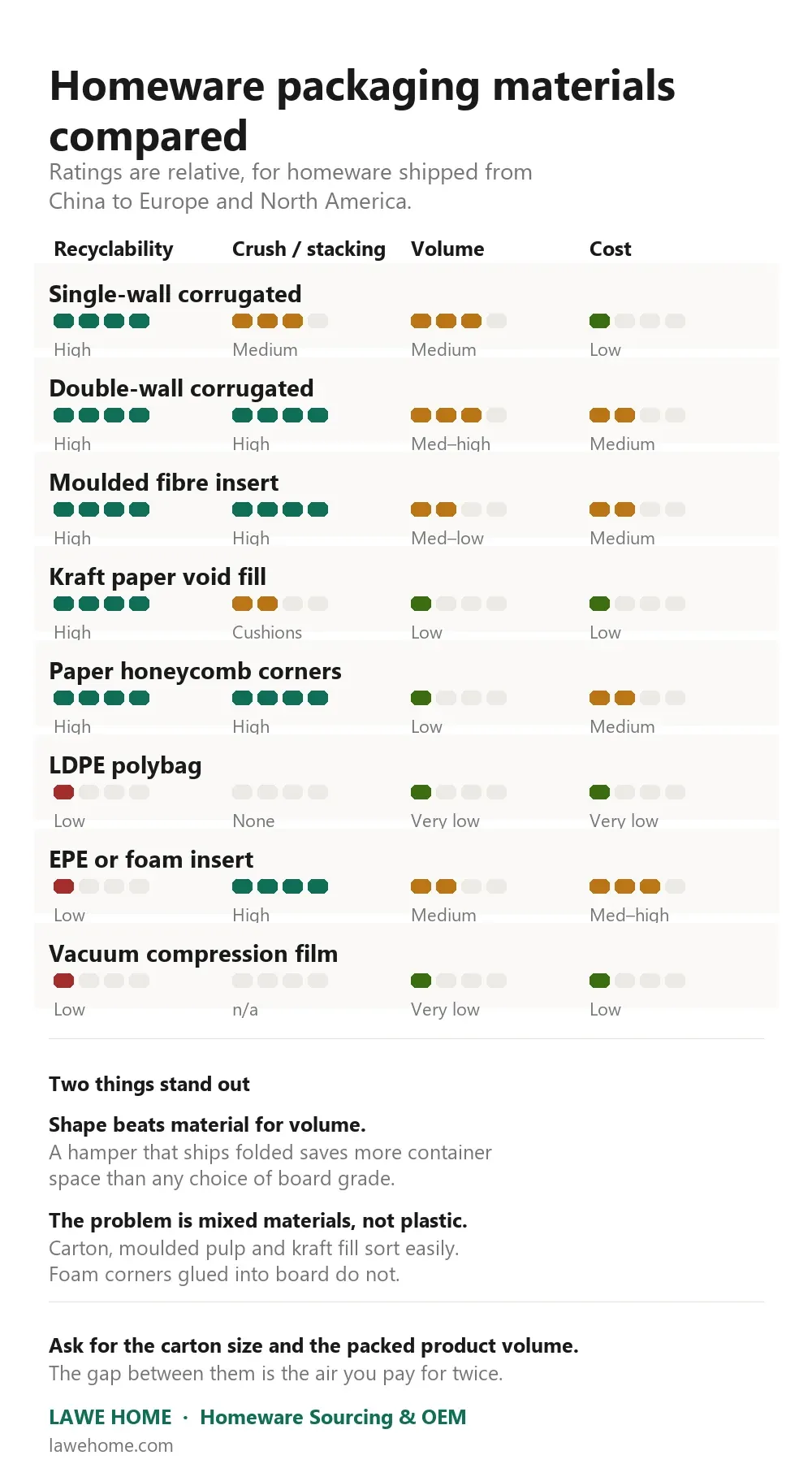
Two things stand out.
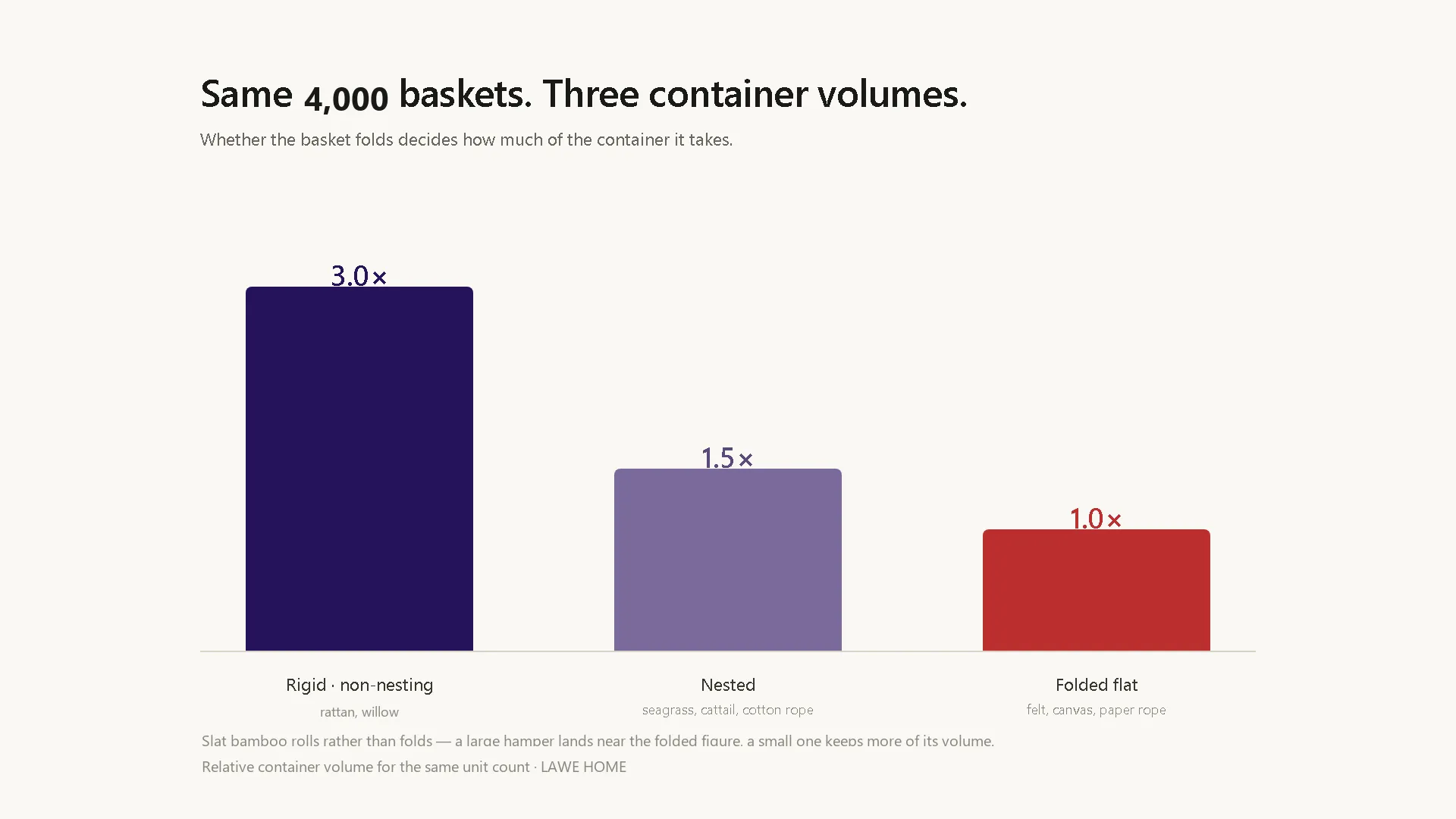
Shape beats material for volume. A hamper that ships folded saves more container space than any choice of board grade.
The recyclability problem is mixed materials, not plastic. Carton, moulded pulp and kraft fill are easy to identify and sort. Foam corners glued into board and unmarked dark plastic are not, and replacing them costs little.
The Product Matters Too
Different goods behave differently in transit.
Seagrass and bamboo. Sensitive to moisture, so a sealed carton with no ventilation and no desiccant is how mould starts. A mould claim costs more than any packaging saving recovers.
Rattan and large woven baskets. Strong and heavy. Protection is easy here; volume is the problem.
Fabric, felt and canvas. Foldable and compressible, so these are your fastest volume win.
Pet beds. Compression helps to a point. Fillings need time to recover, and a bed that arrives flat and stays flat turns into a return.
Pallets and Parcels Need Different Cartons
Retail distribution. Goods move as a unit: cartons stacked on a pallet, wrapped, handled by machine. The stack does most of the protecting, so what you want is a size that tiles the pallet and the container with no gaps, plus stacking strength at the bottom.
E-commerce and direct-to-consumer. Every parcel is handled alone and opened by a customer, so the carton carries all the protection. It wants a closer fit and a material that is easy to sort at the doorstep.
If you sell both channels, specify both cartons at once. The product does not change, only the packaging, and the extra cost is small. Retrofitting after a damage complaint is not.
Three Changes for Your Next Order
1. Measure the air. Ask for the carton's outside dimensions and the packed product volume. The gap between them is your empty space ratio. Most buyers have never worked it out, and it usually needs no product change.
2. Swap the glued mixed-material parts. Corners, inserts, edge protection. Anything joining two materials is a recyclability problem, and a paper corner replacing a foam one is cheap.
3. Put packaging on the brief at quotation. Say packaging will be specified when you ask for a price. You then get to weigh a tighter carton against damage risk while there is still time to choose.
Want to see this on your own SKU? Browse our collections or send us the SKU, and we will come back with the volume each option occupies.
Frequently Asked Questions
Is less packaging always better?
No. Packaging has to survive handling and a sea leg. Damage costs more than the space it saves.
Does cutting empty space hurt the product?
Fitting a carton closer is usually safe. Compressing filled pet beds is not. Test it on a sample first.
Which material saves the most container space?
Shape, not material. Flat-packing and vacuum compression change volume more than swapping carton board.
Can you redo packaging on a product we already sell?
Yes. Send the current specification and we will come back with two or three options showing volume, protection and cost.
Related products
Ask for a packaging review with your next quotation. Send the SKU and target market, and we will reply with options and the container volume each one uses. → contact us
This article is a commercial overview, not legal advice. Packaging requirements vary by market and by material. Confirm what applies to you against the official text and with your importer.